


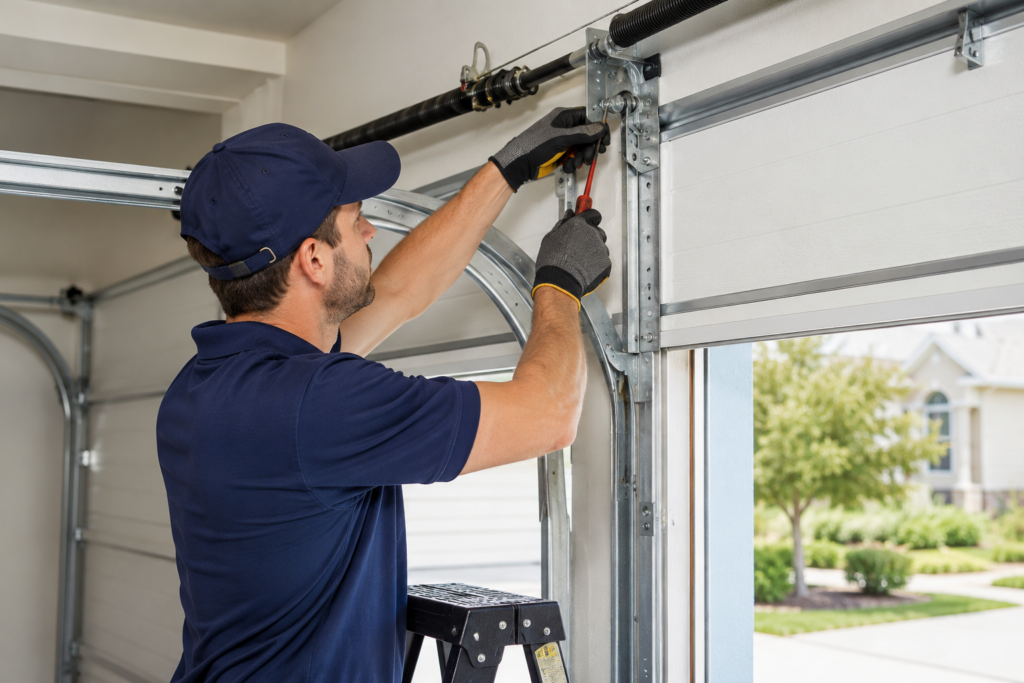
Your garage door weighs a lot more than it looks, and the springs handle most of the work every time it rolls up or down. If you’ve run into garage door heat damage in Palm Desert, there’s a good chance the springs were the first thing to feel it. They sit under heavy tension for years, winding and unwinding several times a day. Pile on a few months of valley heat and the steel starts aging quicker than it should. You get more wear, less give, and a higher chance the thing lets go when you least expect it. So what’s the heat actually doing down there? Here’s the breakdown.
1. Why the heat wears springs out
Desert heat does more than turn the driveway into a griddle. It chips away at the parts you never think about.
- A torsion spring takes on serious tension every single time the door moves.
- High temperatures leave the steel a little less springy with each cycle.
- The metal expands when it’s hot and pulls back when it cools, and that push-pull grinds away at it.
- It’s like bending a paperclip over and over until it finally gives.
- A spring that would coast along for years in a mild climate can give out way early when afternoons hit triple digits.
2. Keep everything greased
Heat doesn’t just stress the steel. It cooks the grease right off it. The lubricant on your springs and rollers thins out, drips, and bakes into a sticky brown film once the garage really heats up. Once that’s gone, you’ve got metal scraping metal, and the springs work harder than they ever should. That’s exactly why lubricating garage doors in summer is worth the five minutes it takes. Grab a silicone or lithium spray made for garage hardware, not whatever oil can is sitting under the kitchen sink, and hit the springs, hinges, rollers, and bearings about once a month. Do it early, before 8 a.m., while the metal’s still cool to the touch.
3. Easy upkeep for desert homes
The desert is rough on a garage door, no way around it. Sand works its way into the tracks, the sun chews up the rubber seals, and the swing from a 110-degree afternoon to a cool night wears on every joint. When folks bring up desert garage door maintenance, it really boils down to a few simple habits. Twice a year, look the springs over for rust, gaps, or any stretching, then check the cables for fraying and sweep the grit out of the tracks. Lift the door halfway by hand and let go. If it drifts up or slides shut on its own, the tension’s off, and it’s time for a tune-up.
4. Why moving metal matters
Steel moves with the temperature, plain and simple. Hot afternoon, it expands a hair. Cool night, it shrinks back down. That daily back-and-forth is what’s called thermal expansion in garage doors, and over time it backs out screws and nudges the tracks out of alignment. It also messes with the exact tension your springs were set to. A door that ran perfectly in January can feel off by July, stopping in the wrong spot or sitting low on one corner. The springs notice it most, since they’re tuned for one set load, and the good news is an early catch usually means a quick tension adjustment and a few tightened bolts.
5. Learn to read the warning signs
Most doors give you a heads-up before they quit on you. The loudest one is a sharp bang from the garage with nothing obvious behind it, which is almost always a snapped spring, and out here it tends to land on the hottest part of the day. Watch for a door that opens crooked, jerks partway up, or suddenly feels heavy when you lift it. Rust or a visible gap in the coil counts too. A wound torsion spring holds enough force to seriously hurt you, so leave that one to a trained tech with the right bars, and the second something sounds or feels wrong, stop using the door and call somebody. Pushing a tired spring through one more scorcher is how a cheap fix turns into a four-figure bill.
Heat is the quiet troublemaker behind most garage door headaches out here, and the springs catch the worst of it. They soften, they wear thin, and they drift out of tune faster when it’s blazing outside. Almost all of it is avoidable, though. A little grease, a couple of checkups a year, and an ear tuned for odd noises will keep your door running for a long stretch. Take care of the springs, and they’ll get you through the hottest months without ever stranding your car behind a door that won’t budge.
“Your springs grind through every heat wave out here. Call us at 877-787-3667 to book a pro spring inspection before the next scorcher hits your door. Door Pros are here to help.”
FAQs
Q1: How often should I get my garage door checked in Palm Desert?
Twice a year is the sweet spot in Palm Desert, since summer is so hard on the parts. Try to schedule one of those checks in spring, before the real desert heat shows up.
Q2: Why do garage door springs break so often in the Palm Desert summer?
A Palm Desert summer softens the steel and dries the grease right off, so the springs wear out faster than they would anywhere milder. That’s why most breaks around here happen on the hottest afternoons, usually with a loud bang.
Q3: Can I replace a broken torsion spring myself in Palm Desert?
Better not to. A torsion spring holds enough tension to do real damage, and Palm Desert heat leaves a worn one even harder to predict. A local tech has the gear to handle it safely.